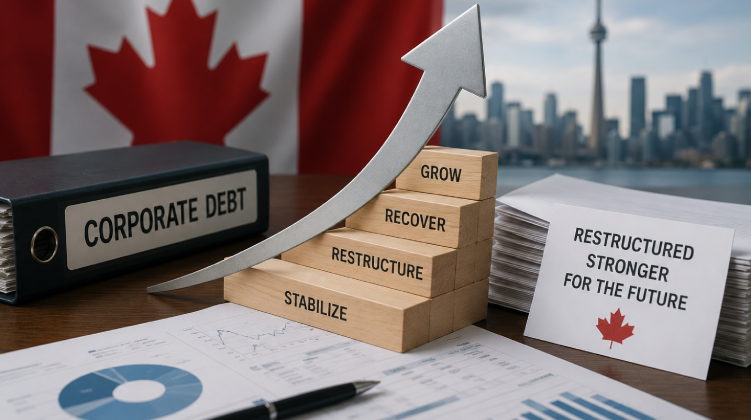
Every successful business experiences periods of financial pressure. Rising operating costs, delayed customer payments, economic downturns, changes in interest rates, and unexpected events can all affect cash flow. While temporary financial challenges are a normal part of operating a business, there comes a point where debt begins to outweigh the company’s ability to recover through ordinary operations.
For many business owners, that realization is difficult. Entrepreneurs often invest years building their companies and naturally want to exhaust every possible option before considering formal restructuring. However, waiting too long can reduce the number of available solutions and make recovery significantly more difficult.
Corporate insolvency is not simply about a company running out of money. It refers to situations where a business is unable to meet its financial obligations as they become due or where the total liabilities exceed the value of its assets. Understanding the different insolvency solutions available in Canada allows business owners to make informed decisions based on the specific circumstances facing their organization.
The right solution depends on the amount of debt, the types of creditors involved, the value of the company’s assets, and whether the business itself remains commercially viable.
Financial distress rarely happens overnight
Businesses generally do not become insolvent because of a single event.
Financial problems often develop gradually. Revenue begins to slow while expenses continue to increase. Profit margins shrink. Cash reserves disappear. Owners begin relying on operating lines of credit or delaying payments to suppliers. Tax remittances may fall behind, and eventually multiple creditors begin demanding payment at the same time.
At first, management may believe the situation is temporary.
Unfortunately, if underlying financial problems are not addressed, debt continues to grow while available financing becomes more difficult to obtain.
Recognizing these warning signs early creates more opportunities to restructure before creditors begin taking enforcement action.
Different types of debt require different strategies
Not every business debt creates the same level of risk.
A company may owe money to banks, equipment finance companies, suppliers, landlords, government agencies, shareholders, or private lenders. Each type of creditor has different legal rights and different priorities during financial restructuring.
For example, secured lenders generally hold security against specific assets such as equipment, vehicles, inventory, or real estate. Unsecured creditors typically do not have direct security over company assets but may still pursue legal collection remedies.
Government debt presents another unique challenge.
Outstanding GST/HST, payroll remittances, and corporate tax obligations can create significant collection pressure because government agencies possess broad legal powers to recover unpaid balances.
Understanding the mix of creditors is one of the first steps in evaluating appropriate restructuring options.
Informal restructuring may work in some situations
If financial problems are relatively recent and the business continues to generate positive cash flow, informal negotiations may resolve the issue.
Businesses sometimes negotiate:
- Extended payment terms with suppliers.
- Loan restructuring with financial institutions.
- Temporary rent adjustments.
- Payment arrangements for certain government obligations.
- Revised contracts with key vendors.
These solutions can be effective when debt remains manageable and the company has realistic prospects for recovery.
However, informal agreements depend entirely on creditor cooperation.
If even one significant creditor refuses to participate, broader restructuring solutions may become necessary.
When formal restructuring becomes appropriate
Once financial problems affect multiple creditors simultaneously, formal restructuring processes often provide more certainty.
Canadian insolvency legislation provides legal frameworks that allow businesses to reorganize debt while attempting to preserve ongoing operations.
The purpose is not simply to delay creditor collection.
Instead, restructuring creates an opportunity for businesses to develop realistic repayment strategies while maintaining as much enterprise value as possible.
Every restructuring proceeding is different because every business has different financial circumstances.
The size of the company, the number of creditors, available assets, industry conditions, and future revenue potential all influence the most appropriate approach.
Small businesses and larger corporations often require different solutions
The complexity of restructuring frequently depends on the size of the organization.
A small privately owned company with several trade creditors and modest tax debt may require a very different process than a national corporation with hundreds of employees, secured lenders, bondholders, and operations across multiple provinces.
Larger organizations often involve more sophisticated restructuring plans because there are more stakeholders whose interests must be considered.
The objective remains the same, however.
Where possible, preserve a viable business while providing an organized process for resolving creditor claims.
The importance of cash flow analysis
One of the biggest misconceptions surrounding insolvency is that total debt alone determines whether restructuring is possible.
In reality, cash flow is often the more important consideration.
A business may owe several million dollars but still generate sufficient operating profits to support restructuring.
Conversely, a company with significantly less debt may have no realistic path toward recovery if operations consistently lose money.
Professional restructuring advice therefore focuses heavily on projected cash flow rather than simply reviewing historical financial statements.
Understanding future earning capacity is critical.
Industry conditions also influence restructuring decisions
Economic conditions can dramatically affect whether restructuring is likely to succeed.
Some industries experience temporary downturns followed by recovery.
Others undergo permanent structural changes that fundamentally alter future demand.
Construction companies, manufacturers, retailers, transportation firms, technology businesses, professional services firms, and hospitality companies all face different market conditions that influence restructuring planning.
Understanding both the company’s financial position and the broader economic environment allows advisors to recommend realistic solutions.
The role of management during restructuring
Business owners often assume that once restructuring begins, they lose all involvement in running their company.
That is not necessarily the case.
Many restructuring processes are designed to allow management to continue operating the business while working toward an agreement with creditors.
Management remains responsible for serving customers, supporting employees, generating revenue, and implementing operational improvements.
Successful restructuring usually requires strong leadership throughout the process.
Owners who remain engaged and committed to improving the business often place their companies in a stronger position for long-term recovery.
Why delaying decisions increases risk
Perhaps the greatest challenge facing financially distressed businesses is uncertainty.
Owners frequently spend months hoping conditions will improve naturally.
Unfortunately, financial problems generally become more expensive over time.
Interest accumulates.
Supplier relationships deteriorate.
Credit availability declines.
Government collection activity may increase.
Employees become concerned about job security.
Customers may lose confidence if operational disruptions become visible.
Taking action early does not necessarily mean entering formal insolvency proceedings.
Often, it simply means obtaining professional advice while multiple options remain available.
Building a stronger business after restructuring
Many well-known companies have experienced periods of financial restructuring before returning to profitable growth.
The process often encourages organizations to improve budgeting, strengthen internal controls, renegotiate supplier relationships, streamline operations, and focus on their most profitable products or services.
Financial restructuring should therefore be viewed as a strategic business decision rather than simply a legal procedure.
Companies that successfully complete restructuring frequently emerge with healthier balance sheets, improved financial discipline, and stronger long-term sustainability.
The key is recognizing financial distress before it becomes irreversible.
Every business faces unique circumstances, and no single restructuring solution fits every organization. The amount of debt, the nature of creditor claims, available assets, projected cash flow, and long-term commercial viability must all be evaluated together before determining the most appropriate course of action. Business owners facing significant financial pressure can benefit from understanding how corporate debt restructuring works in Canada and how early professional advice may provide opportunities to preserve both the business and its future growth.
